 By Michael L. Hogue
 Hello and welcome back to The Hogue Connection! In our last post we looked at the importance of genealogy. In this article, I’d like to look at the best way to start a family tree. That is, start with what we know, and then move on to the details with further research. As simple as this sounds, I tend to rush ahead and research older ancestors, because I’m more excited about what that discovery might bring to light. I can’t wait to study the history behind them. In a bit, I’ll give some examples of what we know about our older Hogue ancestors.
Most every genealogist, pro or amateur, will tell you to start with yourself, record what you know in detail, before moving on to previous generations. It is important to have sources to back up your information, like a birth certificate, for example. Most people my age or younger should have a copy of their birth certificate, and probably one for each of your parents, as well. With these documents, we can start to build a detailed picture of what we know about ourselves and turn that into a detailed family tree.
Start With the Basics…
What we know, or what we want to know, is our birthdate, place of birth (usually listed as city, county, state, and country), and parents. All this info we can glean from our birth certificates. Of course, you are bound to know it anyway; but documenting it now creates a good habit of building sources for future research. Once these facts have been established and written down or recorded in your genealogy data base, we can move on to the next level.
You are building a series of family groups here. Your first family group will consist of you, your siblings, if any, and your parents. Once the details have been documented, then you can move on to the next generation, that of your grandparents. You continue this process for each succeeding generation. You might be lucky; you might know all about your family back to your great-grandparents without any trouble. I feel pretty good about what we know about my family back to the third great-grandparent level. Of course, I’ve been studying it for almost 40 years! A good target, once you get your research routine established, is to shoot for identifying all your great-great grandparents. You have 16 of them.
What We Know About John Hogg…
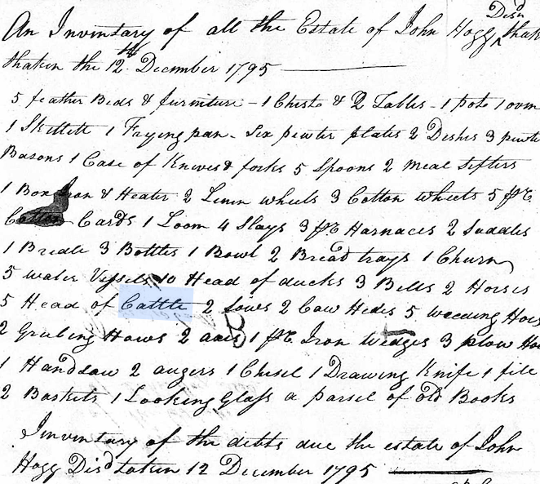
I picked my fifth great-grandfather for this example because; a) we don’t know much about him, b) he is my most important brick wall to break down, and c) because I want to get his name back out there on the internet with this blog post. I want to “refresh” his existence if you will. Most of what we know about John is that he died around 1795 in Franklin County, North Carolina, and left a will to probate. Here is an inventory of his estate:
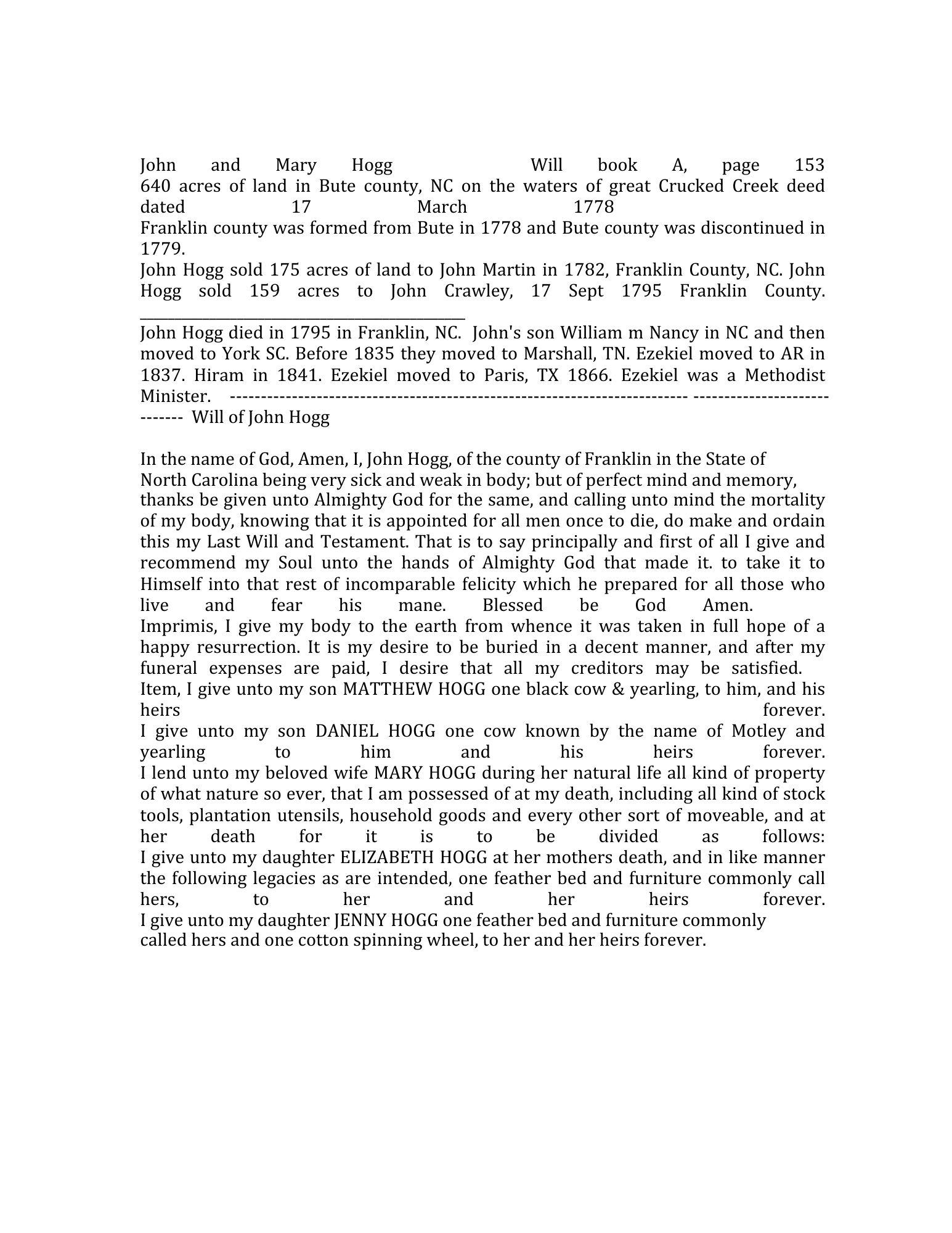
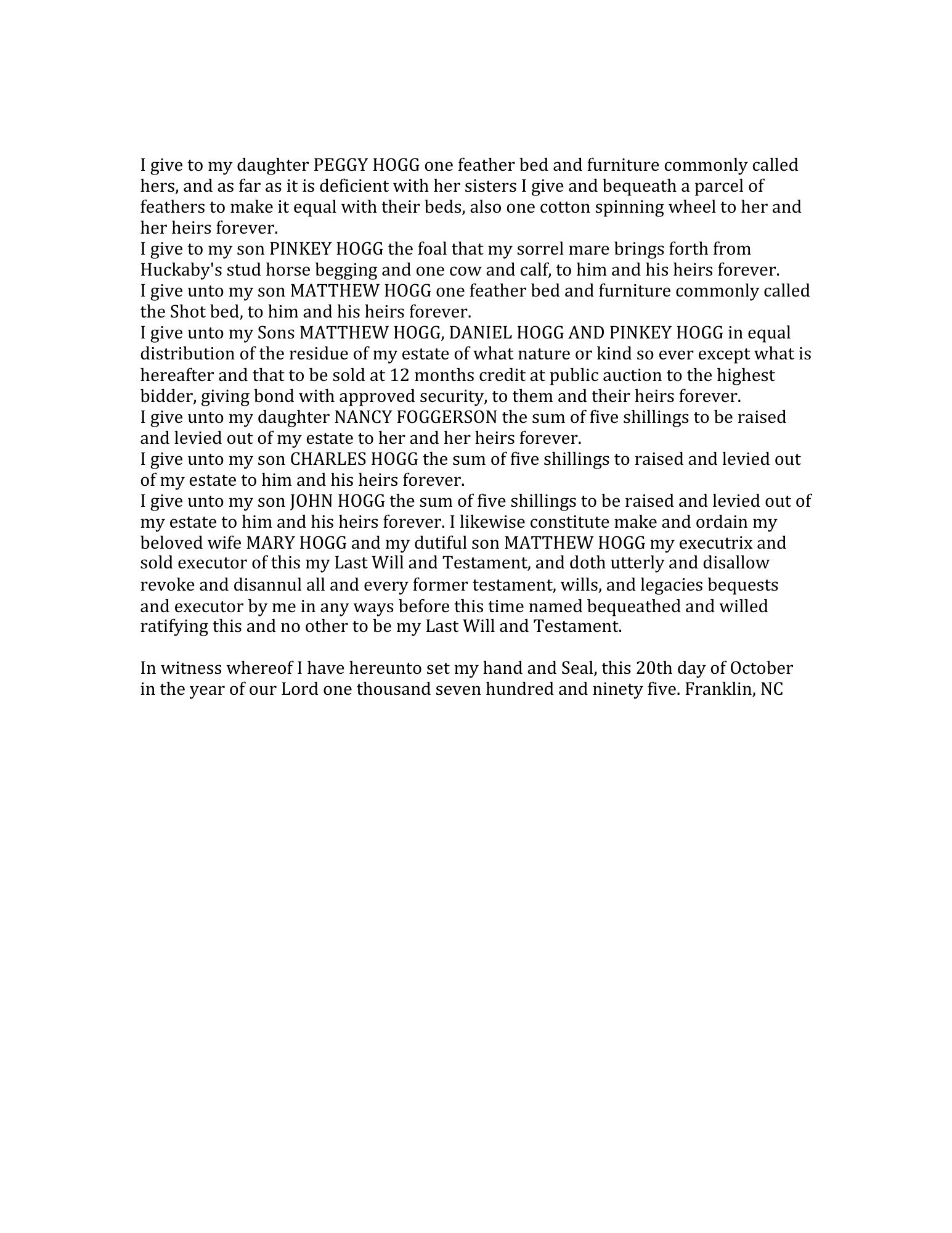
Here is a PDF of some research notes I took and a transcription of John’s will:
What We Know About His Son John Hogg II…
…not much, either. We know that he took his awesome fortune from the settlement of his father’s estate (five whole shillings) and moved across the border of North Carolina into the York District of South Carolina. Sometime after that, he added the “e” to our surname. Again, his will and probate comes into play. Most of what we know about John Hogg II comes from that document. Here is a transcription:
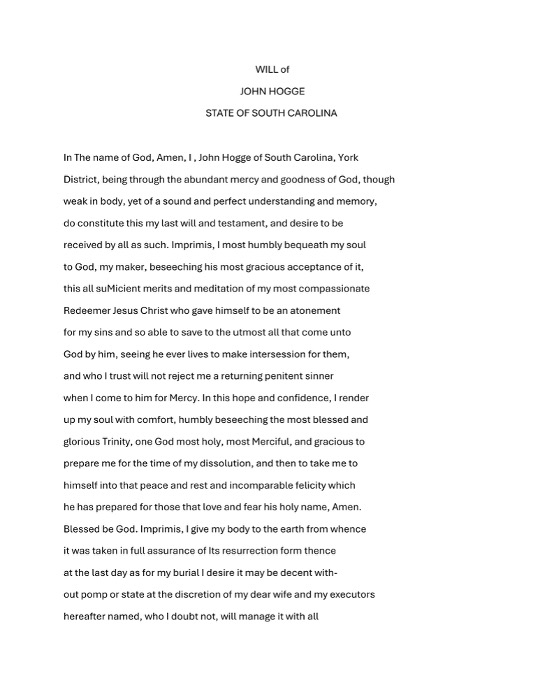
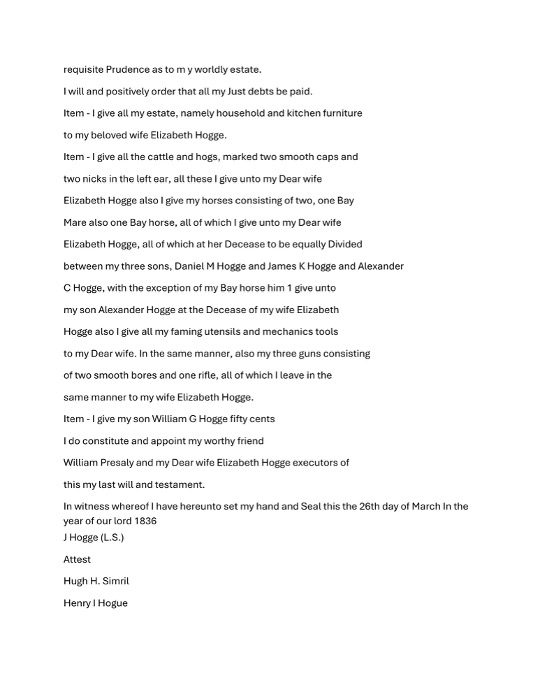
Once again, our next ancestor in line, William G., doesn’t exactly rake in a huge part of this estate.
What We Don’t Know About John Hogg I…
- Date of Birth
- Place of Birth
- Father
- Mother
- Siblings
- Number of marriages
- His history before 1775 or so
So…to all you Hogue cousins out there. Help me break down this brick wall! This connection was established via the Hogg/Hogue DNA Project that you can check out here. Thanks so much for reading my blog and inspecting these old documents. See you back here on my next post. If you would like to return to the Home page, click here.
Hello Mike.
I read your recent post and the ancestry wall, went back to my records from a couple years ago on Hogue and Courtney Flat, as follows started with William Monroe Hogue 1823/1886-William Gideon Hogue1787/1863-John Leroy Hogue 1745/1836-George Hogue1708/1765-William Hoge 1660/1749-James Hoge 1638/1682 George Hoge 1606/1639-John Hoge 1580/1682?-Andrew Haig 1550 1583-Andrew Haig 1518/1583–Scottish decent.
Looks like Hogg/Hogge never entered into my research. Could be wrong on it but makes sense to me, think I will leave as is for now.
Hi Joe-
When I first started my research, I thought we descended from William Hoge (1660-1749). Once I joined the Hogg/Hogue DNA project, I realized that wasn’t true. My fraternal or YDNA more closely matches John Hogg of Franklin, NC. That first lineage is no longer correct. Plus, there are way more Hogues, Hoggs, and Hogges out there than I could imagine.
Oddly, I do descend from William Hogg on my maternal side. William and John are not related at this point.
Thanks for reading!
Mike